Car Battery Keeps Dying Overnight: Parasitic Drain and Other Culprits
Top Level Cars
12 min read
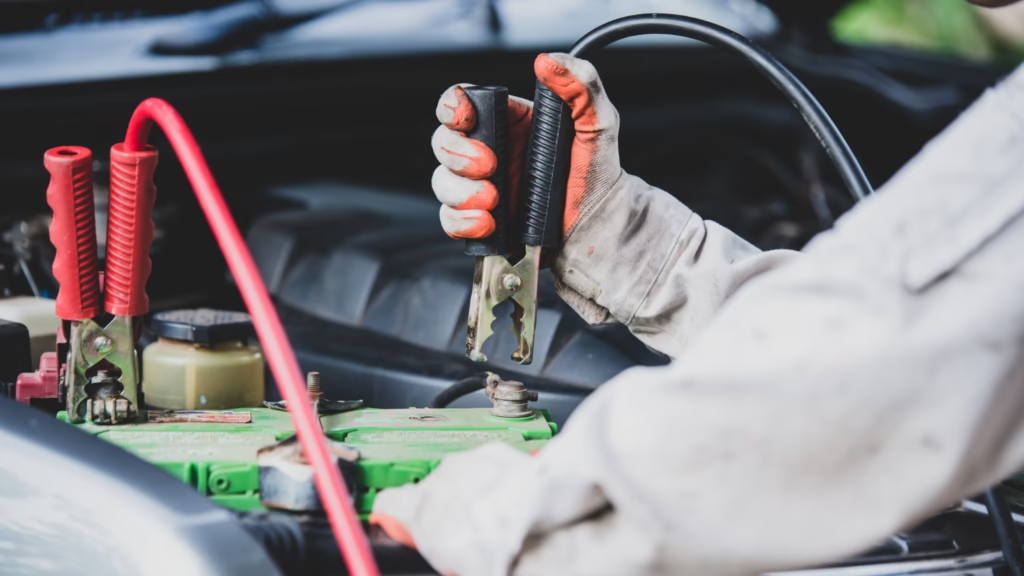
Once a battery starts dying regularly, the jumper cables tend to move from the trunk to the passenger seat. The first jump start feels like a fix. By the third one in a month, it’s clear the car has developed a habit, and the reason usually sits somewhere other than the battery itself.
The timing varies from car to car. Some batteries go flat after a single night in the carport, others after a long weekend parked at the airport, and some give out in a store parking lot half an hour after the engine was switched off. Each of those patterns says something different about where the power is going.
Why Does Your Car Battery Keep Dying?
A car battery keeps dying for one of three reasons: something keeps draining it after you park, the charging system isn’t refilling it while you drive, or the battery itself can no longer hold a charge. Loose or corroded terminals add a fourth possibility, and they can imitate all of the others.
The alternator recharges the battery while the engine runs, the starter and electronics draw power from it, and the battery itself slowly loses capacity with age. Whichever part of that cycle fails, the result looks the same: an engine that clicks instead of cranking. The fix is completely different in each case, though, which is why replacing the battery on a hunch so often ends with the new one dying too.
Parasitic Drain: When Your Car Keeps Using Power After You Park
Parasitic drain is the electrical current your car keeps pulling after the engine is off and the key is out. A small amount is normal, since the clock, alarm, keyless-entry receiver, and various control modules never fully shut down. The problem starts when something draws far more than it should and empties the battery hour by hour.
Think of it like a faucet that doesn’t quite close. A slow drip seems harmless, but leave it for a day or two and the tank is empty. During normal driving the alternator replaces that loss, so the drain only shows when the car sits, whether for one night or a whole week.
The most common sources of excessive drain include:
A light that never turns off. A trunk, glovebox, or vanity-mirror light can stay on when its switch fails, usually somewhere you can’t see it.
Aftermarket electronics. Alarms, remote starters, stereos, and dash cams wired to constant power can keep drawing current around the clock.
Control modules that won’t go to sleep. A faulty module or infotainment unit can keep the car’s electronics awake long after you lock up.
A leaky alternator diode. When one of the diodes inside the alternator fails, current can flow back out of the battery while the car is parked.
Forgotten accessories. A phone charger or cooler left plugged in, or an ignition left in accessory mode, are simple causes that are easy to overlook.
What about key fobs? A proximity fob kept right next to the car keeps it communicating with the receivers, but the extra current is tiny. On its own, a fob rarely flattens a healthy battery. It mostly tips the balance when the battery is already weak.
How to test for parasitic draw with a multimeter
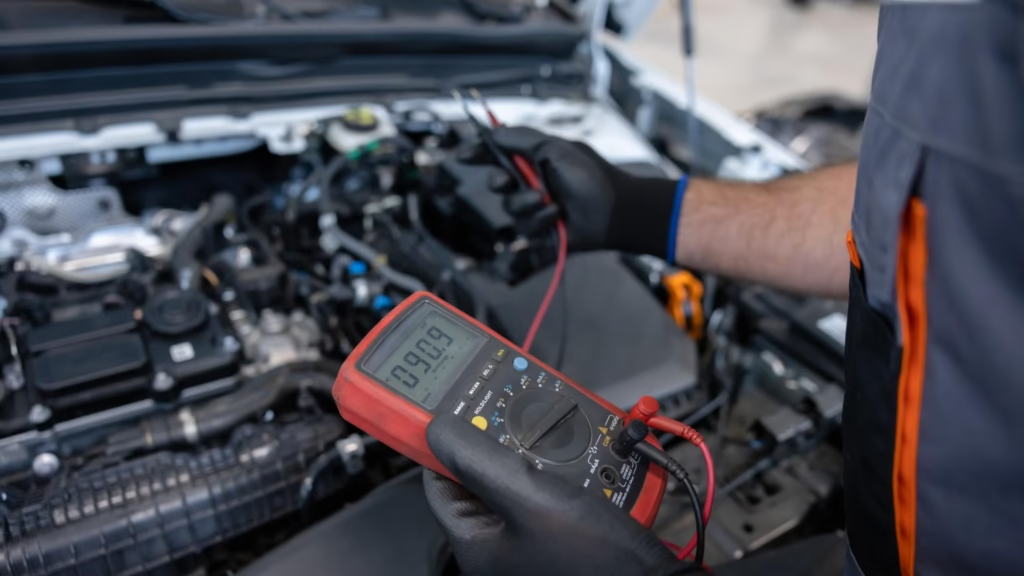
If you’re comfortable working under the hood, a basic home test can confirm whether a drain exists. You’ll need a digital multimeter that can measure current and a bit of patience.
Turn the car off, remove the key, close the doors, and lock the car. If the hood stays open, make sure the under-hood light is off.
Wait for the modules to power down. Many cars settle within 30 minutes, but some newer models need up to an hour before they fully go to sleep.
Set the multimeter to DC amps, starting on the 10 A range to protect the meter, and switch down to milliamps (mA) once you see a low reading.
Disconnect the negative battery cable and connect the meter in series, with one lead on the battery post and the other on the cable you removed.
Don’t open the doors, turn the key, or try to start the car while the meter is connected, because a sudden surge can blow the meter’s internal fuse.
Note the reading, then pull fuses one at a time. When the reading drops sharply, you’ve found the circuit responsible.
As a rule of thumb, older cars should draw less than 50 mA at rest, while many newer cars sit somewhere between 50 and 85 mA because of their extra electronics, according to Universal Technical Institute. The exact spec for your vehicle is in its service information, and a reading well above it points to a problem circuit.
Keep in mind that pulling fuses can wake modules back up and spoil the reading, and some faults appear only now and then, so they may never show up during a single session in the driveway. Tracking those down usually takes shop equipment and a methodical electrical repair process that follows the circuit from the fuse box to the component at fault.
Other Reasons a Car Battery Keeps Dying
Parasitic drain gets a lot of attention, but plenty of batteries die even when the current at rest is perfectly normal. In those cases, the battery is worn out, isn’t being charged properly, or is losing power through a bad connection.
An aging battery that can’t hold a charge
Most car batteries last 3 to 5 years, and in hot climates they tend to land at the shorter end of that range.Battery-testing equipment maker Midtronics puts typical battery life at around 40 months in hot regions, compared with about 55 months in cold ones, because heat speeds up the chemical reactions that wear down the plates. As the plates degrade, the battery still charges during a drive but loses that charge faster while parked, and cranking becomes slow and lazy. On Oahu, it pays to understand how heat and humidity affect your car battery, so you can plan a replacement before the old battery makes the decision for you.
A failing alternator
The alternator recharges the battery while the engine runs. When its output drops, every trip starts with a battery that was never fully topped up, and sooner or later it runs flat. What sets this apart from an aging battery is when the symptoms show up. A tired battery causes trouble after the car has been sitting, while a weak alternator causes trouble on the road: a battery warning light, headlights that dim at idle, or accessories that act up while you drive. Those daytime clues are among the most reliable signs of a failing alternator, and they deserve quick attention, because once the battery runs out, a car with a dead charging system can stall in the middle of a drive.
Short trips and long periods of sitting
Starting the engine takes a big gulp of energy, and the alternator needs time to put it back. A car that only makes short hops, like a five-minute drive to the store and back, may never fully recharge, so the battery slowly loses ground week after week. A car that sits for long stretches, such as a second vehicle or one parked during a deployment, has the opposite problem: even a normal resting draw combined with the battery’s own self-discharge will eventually empty it. A battery left partly discharged also develops sulfation, a buildup of crystals on the plates that permanently reduces its capacity.
Corroded or loose battery terminals
A crusty white, green, or bluish buildup on the terminals, or a clamp that wiggles on its post, restricts the flow of current in both directions. The alternator struggles to charge the battery, and the battery struggles to deliver power to the starter, which can look exactly like a dead battery. Island conditions make this more common, since salt air speeds up corrosion on terminals and cable ends, especially on cars parked near the coast.
How to Tell What’s Really Killing Your Battery
Matching the symptom to the likely cause keeps you from replacing parts that were never the problem. Use this table as a starting point, keeping in mind that a car can have more than one issue at the same time.
What you’re seeing
Most likely cause
Battery older than 3 or 4 years, slow cranking, especially after the car sits
Aging battery
Fairly new battery that goes flat after a night or a few days parked
Parasitic drain
Battery warning light, dim headlights, or flickering accessories while driving
Failing alternator
Battery dies after weeks of short trips or long periods without driving
Undercharging
Crust on the terminals, loose clamps, or no-starts that come and go
Corrosion or poor connections
Battery dies again soon after being replaced
Parasitic drain or a charging problem
If the red battery icon on your dash is what started all this, check whether the warning light points to the battery or the alternator before buying any parts. And if the battery tests fine but the car still refuses to crank, the trouble may lie with the starter or the cables.
If you’ve already replaced the battery and the new one died too, look elsewhere for the cause. In most cases, something in the car is draining the battery or failing to charge it.
Habits That Keep Your Battery From Dying on Oahu
A few simple routines go a long way toward keeping the jumper cables in the trunk, where they belong:
Clean the terminals regularly and make sure both clamps are snug.
Unplug chargers, dash cams, and other accessories when the car will sit for a while, and make sure the ignition is fully off.
Keep your key fob a little farther from the car when it’s parked, especially if the battery is getting old.
If most of your trips are short, add a longer drive of half an hour or so every week. For a car that sits for weeks, a battery maintainer keeps the charge up.
Have the battery load tested once a year after it turns two, since heat wears batteries out faster than most drivers expect.
When to Call Top Level Cars for Battery and Electrical Diagnostics
If you keep reaching for the jumper cables or the home test left you with more questions than answers, it’s time for a proper check. At Top Level Cars in Waipahu, a vehicle no-start diagnostic covers the whole chain: we test the battery under load to see whether it still holds up, check that the alternator is charging correctly, and measure how much current the car draws at rest to catch any parasitic drain. Once we know which part is at fault, we fix that part and leave the healthy ones alone.
Waiting it out rarely helps. Every time a battery is drained flat, it loses a little more of its capacity, so a problem left alone tends to wear out the battery as well. If your car battery keeps dying, book an appointment at our Waipahu shop and we’ll find out where the power is going, so the next turn of the key ends with a running engine.
Car Battery Keeps Dying: Your Questions Answered
What drains a car battery when the car is off?
A small current always goes to the clock, alarm, keyless-entry receiver, and control modules. Excessive drain usually comes from a light that stays on, a module that won’t go to sleep, aftermarket electronics wired to constant power, or a leaky alternator diode.
How much parasitic draw is normal?
Older cars typically draw less than 50 mA once all the modules shut down, while many newer cars with more electronics stay between 50 and 85 mA. A reading well above your vehicle’s spec points to a circuit that isn’t switching off.
Can a key fob drain a car battery?
A modern proximity fob kept close to the car adds only a tiny current and won’t flatten a healthy battery on its own. It mainly becomes a problem when the battery is already old or weak.
How long can a car sit before the battery dies?
A healthy battery in a car with normal resting draw can usually sit for two weeks or more and still start. An older battery, constant heat, or lots of always-on electronics shorten that window, and a parasitic drain can cut it down to a single night.
How do I know if it’s parasitic drain or just an old battery?
If the battery is fairly new and goes flat only after the car sits, parasitic drain is the likely cause. If it’s older than three or four years and cranks slowly even after a full charge, age has probably caught up with it. A load test settles the question.
Why does my car battery keep dying after I replaced it?
A new battery that keeps going flat usually means the old one wasn’t the real problem. Parasitic drain and a failing alternator are the most common causes, though corroded cable ends or very short daily trips can also be to blame. An electrical test will show which one you’re dealing with.
Does Hawaii’s climate make battery problems worse?
Yes. Constant heat speeds up the chemical wear inside the battery, so batteries here often give out sooner than on the mainland. Humidity and salt air add terminal corrosion on top of that, which makes both charging and starting harder.
Read what our satisfied customers have to say about our services.
Great experience. I brought my Prius in for a diagnostic on a dash board error light. Plus I knew that the rear bearings needed to be replaced.
Their attentive behavior was immediate as I scheduled my Monday morning shop visit and the owner responded on a Sunday to schedule.
Even though there was a diagnostic fee the amount was applied to the repair.
In and out in the time committed on the estimate. Clean, very clean facilities from to the waiting room and throughout the shop.
I will continue to use them for future Maintinance and repair’s.
Robert G.
I recently had my Honda serviced at Top Level Cars, and I couldn't be more pleased with the experience. From the moment I walked in, the staff was incredibly welcoming and professional. They took the time to listen to my concerns and provided a detailed explanation of the necessary repairs.
The quality of the work was outstanding. My Honda now runs smoother than ever, and I have complete confidence in the repairs they performed. The technicians clearly know their craft, and their attention to detail was evident in the final result.
What stood out the most was the transparency throughout the entire process. I was kept informed of the progress and costs at every step, ensuring there were no surprises when it came time to settle the bill. The prices were fair and competitive, especially considering the high level of service provided.
Overall, Top Level Cars exceeded my expectations. I highly recommend them to anyone in need of reliable and trustworthy auto service. I will definitely be returning for all my future car maintenance and repair needs.
Denis G.
First impressions: EXCELLENT! We have a Mercedes ML430 that needs some work on. Nick responded immediately and gave us a fair price, the best one we could find on the island. After checking, he recommended only one of the four repairs that others pushed for, and even that with no hurry whatsoever. In fact we felt so well treated by him that we didn’t mind doing his recommended work on our first visit, because we want the good service at TopLevel Cars recognized and paid for. We will definitely return!
Mark M.
If you have car trouble go to Top Level Cars and ask for Demetri! The service was incredible and the cost is the BEST on the island. He was able to take my car in and have it done the same day! He is super knowledgeable and was patient when explaining the work my car needed. I will 100% be bringing my car back for any future services.
Jennifer M.
Top Level Cars are true professionals when it comes to auto repair. I have a Mercedes CL550 that needed servicing. They took me in right away and did an excellent job. I recommend Top Level Cars to anyone who values outstanding service and fair prices. I will only trust Top Level Cars with my car repairs.
Gus N.
The Customer Service here is top notch! Shout out to a great team!! They were the first ones to get back to me and help me with my Tire issue. I have secured my appointment and will be back to have more services done.
Kristina J.
Top Level Cars provided an outstanding experience from start to finish. Their pricing was fair and transparent, exactly as advertised with no surprises. Communication was exceptional; they promptly answered all my questions and kept me informed throughout the process. The service was incredibly fast—I was in and out in no time. They made the entire process smooth and hassle-free. I highly recommend Top Level Cars to anyone looking for a reliable and trustworthy auto repair shop.



 Electronics