How Salt Air Damages Your Car in Hawaii (And Simple Ways to Stop It)
Top Level Cars
11 min read
We put cars on a lift in Waipahu every working day, so we get to see the same story on repeat. A driver comes in for a routine brake job and the pads turn out to be fine. The real problem is a steel brake line so pitted that it weeps fluid every time the pedal goes down hard. The paint is glossy, the interior is spotless, and the truck has never seen snow or road salt in its life.
That is the strange thing about living on Oahu. The same ocean breeze that makes the drive along Farrington Highway worth taking is slowly eating the parts of your car you never look at.
What Is Salt Air Corrosion? How Hawaii’s Coastal Climate Attacks Your Car
Salt air corrosion is the process in which windborne sea-salt particles settle on a vehicle’s metal surfaces, pull moisture out of humid air and speed up oxidation. It rarely announces itself with one dramatic failure. It shows up as steady rusting of brake lines, frame rails and suspension parts hidden from view.
Here is the part that makes salt so much worse than plain water. Sea salt draws moisture straight out of the air, so once it has settled on a frame rail it keeps that metal damp long after the last shower, even on a bright, breezy afternoon. Rinse a car and it dries. Leave the salt on it and the salt keeps working.
You also do not need an oceanfront parking stall to be affected. The trade winds carry salt spray a long way inland, so a car parked in Mililani or Waipahu still picks it up, just more slowly than one parked in Hauula. Add year-round warmth and frequent showers, and the metal under your car spends much of its life damp and salted.
What Salt Air Damages on Your Car
Corrosion does not attack everything equally. Three systems take the worst of it, and they are the three that decide how the car stops, steers and holds together. After those, there is a short list of parts that surprise owners every week.
Salt Corrosion and Brake Lines: Hawaii’s Hidden Safety Risk
Brake lines run the length of your vehicle as steel tubing with a thin protective coating, clipped to the underbody and exposed to whatever the road throws up. Salt settles on those lines and on their fittings, holds moisture against the metal and works from the outside in. Over the years, surface scaling becomes deep pitting, and pitting eventually becomes a pinhole. Salt corrosion of brake lines in Hawaii is a safety issue rather than a cosmetic one, because a hydraulic system only works when it is sealed.
Warning signs to take seriously:
A brake pedal that feels soft, spongy, or sinks slowly under steady foot pressure
Fluid level in the reservoir dropping without an obvious cause
Damp, dark residue on a line, fitting, or the inside of a wheel
Noticeably longer stopping distances, especially downhill or fully loaded
Corroded lines cannot be sanded and saved—they get replaced.
Humidity works on the inside of the system too. Brake fluid slowly absorbs water out of the air, and that water lowers the temperature at which the fluid boils, which is what turns a hard pedal into a soft one on a long downhill run. It also corrodes calipers, cylinders and ABS parts from within. Ask us to test the fluid at every brake service, and plan on replacing it every 2 to 3 years.
Undercarriage rust on Oahu: Why the underbody corrodes first
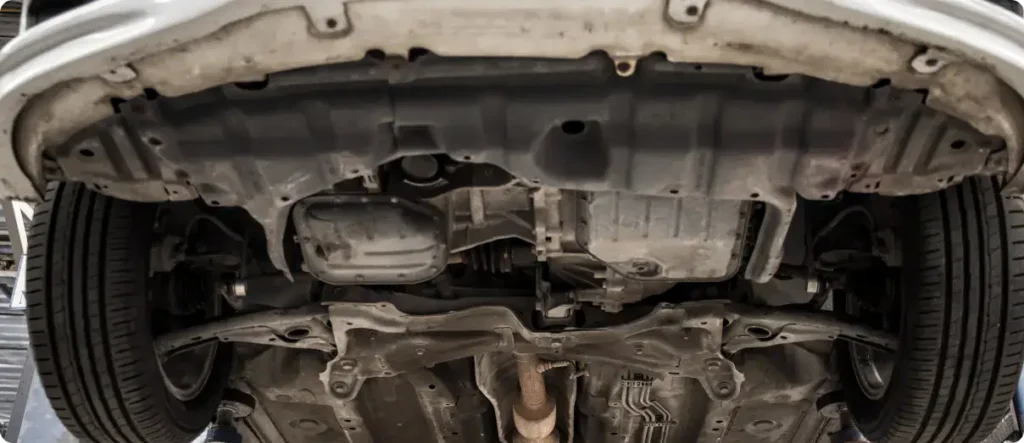
The underbody is the first thing to go, and the reason is simple exposure. It catches road spray from wet pavement, collects settling sea salt and dries slowly because airflow underneath a parked car is poor. Mud, sand and leaf debris packed into frame seams and suspension pockets act like a wet sponge, holding chloride against bare metal for days.
The pattern on our lifts is consistent. Undercarriage rust on Oahu shows up earliest and heaviest on vehicles kept near the water, around Honolulu Harbor and along the windward coastal roads. Every few blocks inland buys you time, and the difference between a beachfront stall and a driveway a mile back is easy to see once the car is in the air. Inland vehicles are not exempt; they are simply on a slower version of the same timeline.
Rust prevention for suspension components
Suspension parts are heavy steel, so people assume they are safe. They are not. Shock and strut bodies, control arms, sway bar links and their mounting brackets, spring seats and the metal shells around rubber bushings all corrode from the outside. As rust builds, shock shafts score their own seals and start leaking, bushings seize instead of pivoting, and fasteners weld themselves in place with oxide.
The effects show up in how the car drives: a harsher, noisier ride, clunks over the Kamehameha Highway expansion joints, cupped or feathered tire wear and steering that wanders. In advanced cases a corroded link or mount can fail outright. Rust prevention for suspension parts is mostly about early detection and clean, quality replacements, because replacing worn shocks and struts before the surrounding hardware seizes keeps a routine job routine. If you already notice signs of a failing suspension, corrosion is often part of the story.
3 more places salt air causes problems
These do not put you on the shoulder of the highway, but they account for a lot of bills that owners did not see coming:
Electrical grounds and connectors. Crusty terminals and corroded ground straps cause slow cranking, dim lights and intermittent sensor faults that get mistaken for expensive electronic gremlins. Cleaning and protecting the connections is usually cheap.
AC condensers and radiators. Thin aluminum fins sit in the airflow behind the grille, and salt eats them from the leading edge. It shows up as an AC that cools less each year, or an engine running hotter than it used to. A gentle rinse of the front of the condenser during a wash helps.
Aluminum wheels and panels. Where aluminum meets steel fasteners, salt water sets up corrosion between the two metals, which is the white powdery bubbling around lug seats and wheel arches. Rinsing the inside faces of the wheels, not just the fronts, makes a real difference.
None of this is guesswork on your part. When a car is on the lift for any other job, ask the technician to walk the underside with you.
Signs Your Car Has Salt Air Damage
Most of these you can check yourself in ten minutes with a flashlight, kneeling beside the car in your own driveway.
What you notice
What it may mean
Orange flakes or scaling on the frame or floor pan
Active undercarriage corrosion, already past surface stage
Squeaks, groans, or clunks over bumps
Seized bushings or rusting shock and strut mounts
Brake fluid that is dark brown instead of light amber
Moisture contamination, which corrodes the system from the inside too
Uneven or feathered tire wear
Alignment shifted by worn or corroded suspension parts
Rattling from underneath at low speed
Loose or rust-damaged heat shields, brackets, or exhaust hangers
Bubbling paint at rocker panels or wheel arches
Rust pushing outward from behind the metal
Slow cranking, dim lights, or odd electrical faults
Corroded battery terminals, ground straps, or connectors
One symptom on its own is worth watching. Two or more together is a good reason to book a salt air vehicle inspection, since the parts a flashlight cannot reach are usually further along than the ones it can.
Coastal Car Maintenance: How Often to Rinse, Inspect and Protect Your Car on Oahu
Good coastal car maintenance is unglamorous and cheap. A garden hose does more for your frame than any additive sold in a bottle.
Rinse the underside every 2 weeks if you park within a few blocks of the ocean, and weekly if you park within sight of the water or regularly drive beach access roads. Fresh water is the whole point. You are washing chloride off, and the dirt that comes with it is a bonus.
Rinse the same day after any beach trip, boat ramp launch, or drive through standing salt water. A sprinkler left under the car for ten minutes works if you do not have an angled wand. Keep the pressure moderate: a jet aimed straight at wheel bearings, CV boots, or connectors pushes water past seals and creates the problem you were trying to prevent.
Wash and wax paint every 2 to 3 months. Wax on painted surfaces plus a rinse for everything else covers most of the car.
Apply an undercoating or corrosion-inhibiting spray annually, ideally before the wetter winter months, which run roughly October through April. Lanolin-based and oil-based inhibitors creep into seams. Hard rubberized coatings can trap moisture if applied over existing rust, so surface prep matters.
Clear debris from drain holes and frame pockets twice a year. Packed sand and leaves hold salt water long after the road has dried.
Skip the non-breathable cover. A tarp thrown over a damp, salty vehicle holds the electrolyte against the metal for days. If you cover your car, cover it dry and use something that breathes.
Choose corrosion-resistant replacement parts. The cheapest brake line, sway bar link, or exhaust hanger is usually the one with the thinnest protective coating, and here that difference is measured in years.
How often should you get a salt air vehicle inspection?
For most Oahu drivers, twice a year is the right rhythm, timed around the rainy season so you catch damage before and after the wettest stretch. If you live along the coast in Waimanalo, Haleiwa, or Ewa Beach, or park outdoors near the water, stay on that six-month schedule without exception. If you are further inland in Kapolei or Pearl City, once a year is usually enough, provided nothing on the symptom list above shows up in between.
Protect Your Car From Hawaii’s Salt Air: Schedule an Inspection at Top Level Cars
Corrosion is one of the few car problems where waiting is guaranteed to cost more. A brake line caught early is a scheduled repair. The same line caught late is a tow, a rushed job and often a set of seized fasteners that turn a one-hour task into an afternoon.
At Top Level Cars we quote before we touch anything, we show you what we found, and we do not pad the estimate with work you do not need. We also know this island’s conditions firsthand, which means we know where to look on a vehicle that has spent its life in the trade winds.
Bring it in for a brake and undercarriage check, plus a full chassis and suspension inspection. We will show you what the salt has been up to.
Common Questions About Salt Air Car Damage on Oahu
Does salt air really damage cars in Hawaii, or is that just a mainland snow-state problem?
It is very real here. Mainland damage comes from road salt in winter, while Hawaii’s comes from airborne sea salt year-round, which means exposure never pauses for a season.
How can I tell if my brake lines are corroded from salt air?
Look along the lines under the car with a flashlight for orange scaling, flaking, or damp residue near fittings. A soft pedal or an unexplained drop in fluid level means you should stop driving it and have it checked immediately.
How often should I rinse the underside of my car if I live near the ocean on Oahu?
Every 2 weeks is a good baseline, and weekly if you park within sight of the water. Always rinse the same day after driving on sand or through salt spray.
Can undercarriage rust be reversed, or does the part need to be replaced?
Light surface rust can be cleaned, treated and sealed. Once corrosion has pitted deeply or perforated the metal, especially on brake lines or structural members, replacement is the only safe option.
Does a garage or a car cover actually help?
A dry, ventilated garage helps a lot, because it keeps salt aerosol and rain off the vehicle. A cover only helps on a car that is clean and dry underneath. Thrown over a damp, salty car, it slows evaporation and makes things worse.
Does living in Kapolei or Pearl City instead of right on the coast actually make a difference?
Yes, and you can see it on the lift. The further you are from the shoreline, the less salt lands on the car, so inland vehicles corrode more slowly. The trade winds still carry enough of it inland that no car on Oahu gets a free pass.
Read what our satisfied customers have to say about our services.
Great experience. I brought my Prius in for a diagnostic on a dash board error light. Plus I knew that the rear bearings needed to be replaced.
Their attentive behavior was immediate as I scheduled my Monday morning shop visit and the owner responded on a Sunday to schedule.
Even though there was a diagnostic fee the amount was applied to the repair.
In and out in the time committed on the estimate. Clean, very clean facilities from to the waiting room and throughout the shop.
I will continue to use them for future Maintinance and repair’s.
Robert G.
I recently had my Honda serviced at Top Level Cars, and I couldn't be more pleased with the experience. From the moment I walked in, the staff was incredibly welcoming and professional. They took the time to listen to my concerns and provided a detailed explanation of the necessary repairs.
The quality of the work was outstanding. My Honda now runs smoother than ever, and I have complete confidence in the repairs they performed. The technicians clearly know their craft, and their attention to detail was evident in the final result.
What stood out the most was the transparency throughout the entire process. I was kept informed of the progress and costs at every step, ensuring there were no surprises when it came time to settle the bill. The prices were fair and competitive, especially considering the high level of service provided.
Overall, Top Level Cars exceeded my expectations. I highly recommend them to anyone in need of reliable and trustworthy auto service. I will definitely be returning for all my future car maintenance and repair needs.
Denis G.
First impressions: EXCELLENT! We have a Mercedes ML430 that needs some work on. Nick responded immediately and gave us a fair price, the best one we could find on the island. After checking, he recommended only one of the four repairs that others pushed for, and even that with no hurry whatsoever. In fact we felt so well treated by him that we didn’t mind doing his recommended work on our first visit, because we want the good service at TopLevel Cars recognized and paid for. We will definitely return!
Mark M.
If you have car trouble go to Top Level Cars and ask for Demetri! The service was incredible and the cost is the BEST on the island. He was able to take my car in and have it done the same day! He is super knowledgeable and was patient when explaining the work my car needed. I will 100% be bringing my car back for any future services.
Jennifer M.
Top Level Cars are true professionals when it comes to auto repair. I have a Mercedes CL550 that needed servicing. They took me in right away and did an excellent job. I recommend Top Level Cars to anyone who values outstanding service and fair prices. I will only trust Top Level Cars with my car repairs.
Gus N.
The Customer Service here is top notch! Shout out to a great team!! They were the first ones to get back to me and help me with my Tire issue. I have secured my appointment and will be back to have more services done.
Kristina J.
Top Level Cars provided an outstanding experience from start to finish. Their pricing was fair and transparent, exactly as advertised with no surprises. Communication was exceptional; they promptly answered all my questions and kept me informed throughout the process. The service was incredibly fast—I was in and out in no time. They made the entire process smooth and hassle-free. I highly recommend Top Level Cars to anyone looking for a reliable and trustworthy auto repair shop.



 Tips
Tips