Humming Noise While Driving: Bearing, Tires, or Suspension?
Top Level Cars
10 min read
Ask five drivers to describe the same noise and you’ll hear five different words: humming, droning, whirring, roaring, “like an airplane.” Ask them what’s causing it, and most will say “wheel bearing,” because that’s the first answer a quick search turns up. Sometimes they’re right. Just as often, the bearing turns out to be fine and the sound is coming from a set of cupped tires, or from a tired shock absorber that has been quietly chewing up the tread for months. Replacing the wrong part costs real money and leaves the hum exactly where it was, which is why it pays to collect a few clues before anyone picks up a wrench.
Why a Speed-Related Hum Is So Hard to Pin Down
A hum that rises with road speed is, almost by definition, a rotational noise. Its pitch follows the speed of the wheels, and the wheel bearing, the tire, and the brake rotor at each corner all turn at exactly that rate. That’s why a worn bearing and an unevenly worn tire can sound practically identical from the driver’s seat: they share the same “frequency source.”
Your ears are also less reliable than they seem. Vibration travels through the subframe, the body shell, and the floor pan, so a noise that starts at the rear left wheel can appear to come from the front right. Many drivers are certain about the side, and many of them are wrong. That’s why technicians road-test with specific maneuvers rather than relying on impressions, and why some shops clip small electronic microphones to each wheel hub to compare corners directly.
There’s one more variable to rule out: the drivetrain. A noise that follows your tachometer (engine speed) rather than your speedometer points toward the engine, accessories, or transmission. A noise that stays the same when the transmission is briefly shifted to neutral at speed belongs to the wheel end. On rear-wheel, four-wheel, and all-wheel drive vehicles, a worn differential can also hum in step with road speed, but it usually changes character as you get on and off the throttle, which a bearing or tire hum rarely does.
Is It a Wheel Bearing? Signs to Listen and Feel For
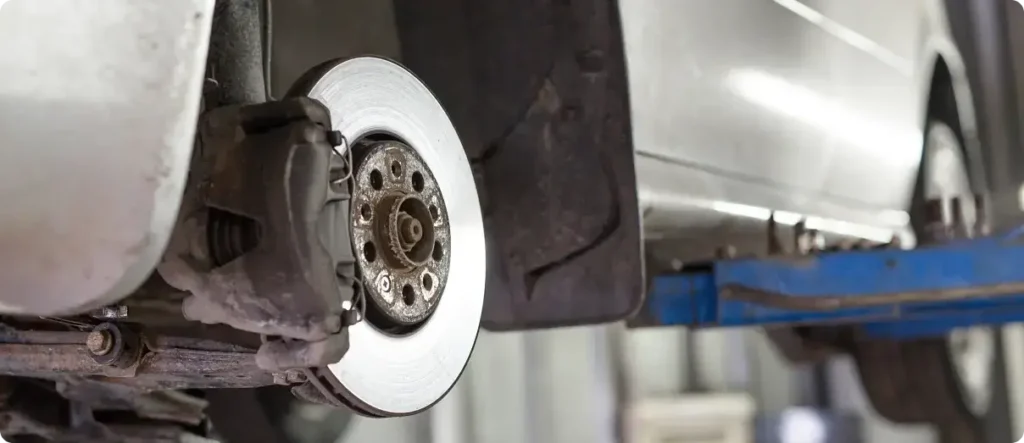
A failing wheel bearing is one of the most common sources of a speed-related hum, and it has a few tells that set it apart. The most useful one shows up during gentle, sweeping turns or lane changes. As the car leans, weight shifts onto the outside wheels, loading their bearings and unloading the ones on the inside. If the hum swells when you steer left and fades when you steer right, the right-side bearing is the usual suspect, and the opposite pattern points to the left. It’s a strong hint rather than a verdict, but it narrows the search quickly.
Here are the most telling bad wheel bearing symptoms to listen and feel for:
A hum or growl that changes when you load one side of the car in a turn
A noise that keeps getting louder as speed builds and stays put regardless of the road surface
A faint vibration through the steering wheel, floor, or seat
Vague or wandering steering, plus play a technician can feel by rocking the lifted wheel
An ABS or traction control light, since many hub assemblies carry the wheel speed sensor and excessive bearing play can disrupt its signal
If this matches what you’re hearing, take a look at the seven wheel bearing symptoms you shouldn’t ignore to judge how urgent it is. Bearings don’t recover on their own, and today’s hum can turn into a grind, or in a worst case a wheel that binds, further down the road.
Could It Be Your Tires? Uneven Wear, Rotation, and Road Conditions on Oahu
Before you assume the worst, give your tires a close look, because they’re the most common impostor in the humming game. Irregular wear is the usual reason. Cupping (scalloped dips around the tread), feathering (tread blocks worn sharp on one edge), and heel-toe wear all create a rhythmic drone that rises with speed and can sound almost exactly like a bearing. Run your palm across the tread in both directions: if it feels smooth one way and saw-toothed the other, you’ve likely found at least part of the problem. Our guide to checking your tires at home walks through the wear patterns worth looking for.
Tread design matters too. Aggressive all-terrain and mud-terrain tires, a popular choice on Oahu trucks and SUVs, hum noticeably even when new, and the noise grows as the blocks wear unevenly. One clue separates tire noise from bearing noise particularly well: tire hum often changes pitch when you move from one pavement type to another, for example from smooth new asphalt onto coarse, older concrete. A bearing doesn’t care what it’s rolling on.
Oahu is especially hard on rubber. Rough, patched roads, constant heat, and strong UV accelerate wear and aging, and a slightly misaligned car will start cupping or feathering its tires sooner than it would in a cooler climate. NHTSA’s TireWise maintenance guidance recommends rotating tires sooner than the usual interval whenever uneven wear appears, and it lists noise and vibration among the performance changes worth taking to a tire professional. A rotation is also a handy diagnostic: if the hum moves to a different corner along with the tire, the tire is your culprit; if it stays put, suspect the bearing. When wear is to blame, our tire inspection and replacement services can determine whether a rotation, a rebalance, or a new set is the right call.
The Suspension Connection: How Worn Shocks and Struts Lead to a Hum
Worn suspension parts rarely hum on their own. Tired shocks, struts, control arm bushings, and ball joints typically announce themselves with clunks, knocks, and creaks over bumps, plus a floaty or bouncy ride. Their connection to a hum is usually indirect, which is exactly why suspension wear gets overlooked.
A shock absorber that no longer controls the wheel lets the tire bounce slightly as it rolls. Every bounce scrubs a small patch of tread, and over thousands of miles that produces the cupped wear pattern described above, which then hums. Worn bushings and ball joints work in a similar way, allowing the wheel’s angles to shift under load and feathering the tread. Cupped tread is one of the classic symptoms of bad shocks and struts, along with nose-diving under braking and a car that keeps bouncing after a dip. The one suspension part that can make a sound of its own when you turn is the strut mount bearing on the front struts, which tends to groan or creak at low speed and in parking lots.
If your tires are cupped and your shocks are worn, a new set of tires will only silence the hum for a while. The suspension will wear the replacements into the same pattern, so both problems need fixing together.
Wheel Bearing vs. Tires vs. Suspension: Quick Comparison
Sometimes the fastest way to narrow things down is to see all three side by side. Use this as a cheat sheet the next time the hum shows up, keeping in mind that two causes can be present at once, most often worn suspension and the cupped tires it produces.
Noise source
When the sound gets worse
Extra symptoms to watch for
Wheel bearing
Builds steadily with speed; changes when you load one side in a turn; unaffected by road surface
Faint vibration, vague steering, play in the wheel, possible ABS or traction control light
Tires
Rises with speed; changes pitch on different pavement types; moves to another corner after a rotation
Cupped, feathered, or heel-toe tread wear; aggressive all-terrain tread
Suspension
Rarely hums by itself; clunks, knocks, or creaks over bumps and dips
Bouncy ride, nose-dive when braking, cupped tires that keep coming back
How wheel alignment fits into the picture
Alignment ties two of these causes together. When your wheels are out of alignment, the tires scrub against the road at a slight angle and wear unevenly, while suspension components carry uneven stress. A bad alignment can therefore quietly deepen both a tire hum and a suspension complaint. As we always say here at Top Level Cars, a professional wheel alignment after new tires or any suspension is one of the cheapest forms of insurance you can buy: it keeps small issues from snowballing into expensive ones.
Get That Hum Diagnosed in Waipahu Before It Gets Worse
A hum tells you that something is rotating unevenly. It doesn’t tell you what, and swapping parts based on a hunch is how drivers end up paying twice. What you need first is a straight answer, and our full diagnostic inspection gives you one before any work begins, whether the cause turns out to be a bearing, a tire, or chassis and suspension work.
Don’t wait for that steady hum to turn into a grind. Call Top Level Cars in Waipahu today, book your diagnosis, and drive home with peace of mind instead of a mystery noise.
Your Questions About That Humming Noise
Why does my car make a humming noise that gets louder the faster I drive?
A hum that rises with speed almost always comes from something that turns with the wheels, most often a worn wheel bearing or an unevenly worn tire. Because both follow wheel speed, a proper inspection is the only sure way to tell them apart.
How can I tell if the noise is coming from my wheel bearing or my tires?
A bearing hum usually changes when you load one side of the car in a turn, while a tire hum tends to change with the road surface. A tire rotation is a common test: if the noise moves with the tire, the tire is to blame; if it stays put, suspect the bearing.
Can bad tires cause a humming noise even if they still have tread left?
Yes. Uneven wear patterns such as cupping or feathering, along with aggressive off-road tread designs, can drone loudly even with plenty of tread remaining. How evenly a tire wears matters just as much as how deep the tread is.
Does a bad transmission make a humming noise?
It can, but transmission hums usually follow engine RPM or appear in a specific gear rather than at a specific road speed. A differential on a rear-wheel, four-wheel, or all-wheel drive vehicle can hum with road speed too, though it usually changes when you accelerate or lift off the gas. If the sound follows your speedometer and ignores the throttle, wheels, tires, or suspension are the more likely source.
Is it safe to keep driving with a humming wheel bearing?
For a short time and at moderate speeds, usually, but it’s not something to ignore. A failing bearing can progress from a hum to a grind and eventually to a wheel that binds or develops dangerous play, so have it checked promptly.
How long will a wheel bearing last after it starts humming?
There’s no reliable mileage figure. Some bearings hum for months, others deteriorate within weeks, depending on how worn they are and how the car is driven. Once the noise starts, treat it as borrowed time and get it inspected before it worsens.
Read what our satisfied customers have to say about our services.
Great experience. I brought my Prius in for a diagnostic on a dash board error light. Plus I knew that the rear bearings needed to be replaced.
Their attentive behavior was immediate as I scheduled my Monday morning shop visit and the owner responded on a Sunday to schedule.
Even though there was a diagnostic fee the amount was applied to the repair.
In and out in the time committed on the estimate. Clean, very clean facilities from to the waiting room and throughout the shop.
I will continue to use them for future Maintinance and repair’s.
Robert G.
I recently had my Honda serviced at Top Level Cars, and I couldn't be more pleased with the experience. From the moment I walked in, the staff was incredibly welcoming and professional. They took the time to listen to my concerns and provided a detailed explanation of the necessary repairs.
The quality of the work was outstanding. My Honda now runs smoother than ever, and I have complete confidence in the repairs they performed. The technicians clearly know their craft, and their attention to detail was evident in the final result.
What stood out the most was the transparency throughout the entire process. I was kept informed of the progress and costs at every step, ensuring there were no surprises when it came time to settle the bill. The prices were fair and competitive, especially considering the high level of service provided.
Overall, Top Level Cars exceeded my expectations. I highly recommend them to anyone in need of reliable and trustworthy auto service. I will definitely be returning for all my future car maintenance and repair needs.
Denis G.
First impressions: EXCELLENT! We have a Mercedes ML430 that needs some work on. Nick responded immediately and gave us a fair price, the best one we could find on the island. After checking, he recommended only one of the four repairs that others pushed for, and even that with no hurry whatsoever. In fact we felt so well treated by him that we didn’t mind doing his recommended work on our first visit, because we want the good service at TopLevel Cars recognized and paid for. We will definitely return!
Mark M.
If you have car trouble go to Top Level Cars and ask for Demetri! The service was incredible and the cost is the BEST on the island. He was able to take my car in and have it done the same day! He is super knowledgeable and was patient when explaining the work my car needed. I will 100% be bringing my car back for any future services.
Jennifer M.
Top Level Cars are true professionals when it comes to auto repair. I have a Mercedes CL550 that needed servicing. They took me in right away and did an excellent job. I recommend Top Level Cars to anyone who values outstanding service and fair prices. I will only trust Top Level Cars with my car repairs.
Gus N.
The Customer Service here is top notch! Shout out to a great team!! They were the first ones to get back to me and help me with my Tire issue. I have secured my appointment and will be back to have more services done.
Kristina J.
Top Level Cars provided an outstanding experience from start to finish. Their pricing was fair and transparent, exactly as advertised with no surprises. Communication was exceptional; they promptly answered all my questions and kept me informed throughout the process. The service was incredibly fast—I was in and out in no time. They made the entire process smooth and hassle-free. I highly recommend Top Level Cars to anyone looking for a reliable and trustworthy auto repair shop.




 Tips