What to Do If Your Car Breaks Down: A Step-by-Step Safety Guide
Top Level Cars
10 min read
It usually happens at the worst possible moment: westbound on the H-1 at 4:30 p.m., cars packed bumper to bumper, and suddenly the steering feels heavy, the temperature needle climbs, or the engine simply quits. Your instinct says stop right now. Acting on that instinct in a live traffic lane is how a mechanical problem turns into a collision, especially on a stretch of highway where the shoulder is barely wider than your car. The good news is that the safest response is a short, learnable sequence: four or five decisions you can make in under a minute, even with your heart pounding. Learn it once, and you’ll never freeze on the side of Farrington Highway wondering what comes next.
Pull Over Safely and Get Off the Road
A stalling car still carries momentum, and the steering and brakes keep working. They simply get heavier once the engine stops helping them, so use them deliberately instead of panicking.
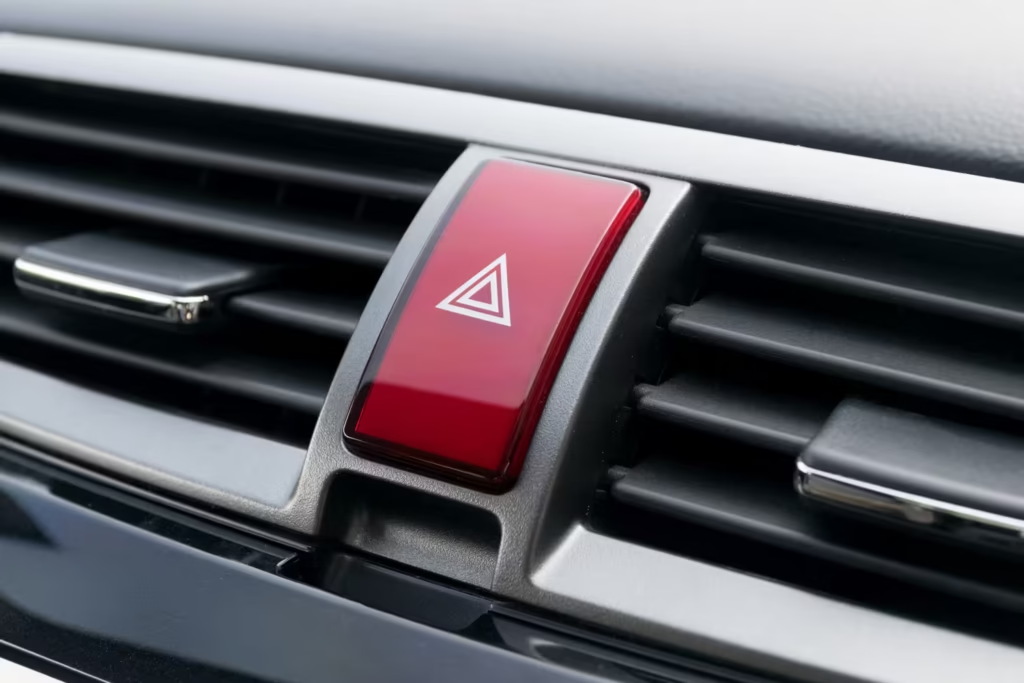
Signal early, and switch your hazards on. Turn your indicator on before you start moving over, and add the hazard lights as soon as you’re rolling noticeably slower than the traffic around you. Drivers behind you need to understand what’s happening while you still have room to maneuver.
Lift off the gas instead of slamming the brakes. Coasting keeps you predictable, and hard braking in dense traffic invites a rear-end hit. If the engine has already stalled, the vacuum reserve gives you only a press or two of assisted braking, so brake firmly and steadily rather than pumping the pedal.
Aim for the widest safe spot you can reach. A full shoulder, an exit ramp, a gas station, or a parking lot beats stopping in a travel lane every time. If you can nurse the car another 200 yards to a real pull-off, do it.
Park so the car cannot roll into a lane. Straighten out parallel to the road, leave the transmission in park (or in gear on a manual), set the parking brake, and angle the front wheels slightly toward the guardrail.
Stay buckled until you’ve assessed the situation. Your seat belt is still the best protection you have while stopped near moving traffic.
Local reality matters here. Stretches of the H-1 through town and long sections of Farrington Highway have shoulders that vanish without warning, often with a concrete barrier where you were hoping for open ground. Sudden showers cut visibility in seconds and lift oil off warm asphalt, so plan your pull-over sooner and slower than you think you need to. On a two-lane road out toward Waianae or up on the North Shore, look for a driveway or a turnout rather than trusting a narrow gravel edge that softens in the rain.
Turn On Hazard Lights and Make Yourself Visible
Once you’ve stopped, your only job is making sure other drivers see you long before they reach you. For the first ten minutes, visibility matters far more than any repair.
Hazard lights stay on. If they aren’t already flashing from the pull-over, turn them on before you unbuckle and before you call anyone.
Place a reflective triangle or flares roughly 100 feet behind the car, but only if you can do it without stepping into a traffic lane. On a barrier-lined freeway shoulder, skip it.
Never stand behind or directly in front of your vehicle. That’s the exact spot an inattentive driver will hit. If you have to be outside, get beyond the guardrail and put real distance between yourself and the car. AAA suggests at least 40 feet, so that flying debris misses you if your car is struck.
Get out on the side facing away from traffic. On a right-hand shoulder that’s the passenger door. If you’ve ended up on the left shoulder or in the median, the passenger side faces the lanes, so use the driver’s door and only during a genuine gap in traffic.
At night, add light. Interior dome light on, phone flashlight in hand, and if you keep a reflective vest in the trunk, wear it. Streetlights are sparse once you’re past Kapolei or headed toward Kahuku.
Roadside assistance professionals recommend the same sequence. AAA advisesstaying belted inside the vehicle with your hazards on until help arrives, and getting out only when you can move well away from traffic. In heavy rain or after dark, inside the car is almost always the safer place to wait.
Check What’s Safe to Check, Then Call for Help
Now you can look at what went wrong, and there’s a firm line between a quick glance and an actual roadside repair. Use the symptoms to decide whether the car moves again under its own power or on a flatbed.
Symptom
Likely cause
Safe to keep driving?
Steam from under the hood, sweet syrupy smell, temperature gauge in the red
Overheating, coolant leak, failed hose, radiator or water pump
No. Shut the engine off and do not open the hood
Burning smell, smoke, oily haze
Oil leak onto hot exhaust, slipping belt, electrical short
Usually short distances only, and get it scanned within days
Check engine light flashing
Active misfire, catalytic converter at risk
No. Every mile costs you money
Engine cranks but never fires
Fuel delivery, ignition, or starting-system fault
You’re not going anywhere, so call for help
Brake pedal that feels soft or sinks toward the floor, or grinding from the wheels when you brake
Brake fluid leak, air in the system, badly worn pads
No. Tow it
Two hard rules. First, a hot cooling system sits pressurized well above the boiling point of water, so opening the radiator cap or the coolant reservoir can spray scalding coolant over you. Let the engine sit for at least 30 to 45 minutes before you touch anything, and if it’s still steaming, leave the hood closed. There is nothing out there you can safely fix anyway.
Second, a car that cranks but won’t fire calls for a diagnosis rather than a guessing game. Long cranking drains the battery and overheats the starter, so stop after about ten seconds, rest, and don’t keep trying every couple of minutes. Knowing the most common reasons a car won’t start helps you describe the symptom accurately over the phone, and confirming which one it is takes a proper no-start diagnosis at the shop. Call for roadside assistance any time you’re on a freeway shoulder, in the rain, after dark, or simply unsure.
Common Mistakes to Avoid When Your Car Breaks Down
Most roadside injuries and most oversized repair bills come from a handful of predictable errors.
Standing behind the car or in a lane. It feels productive to look at the trunk or wave traffic around. It’s the single most dangerous thing you can do at the roadside.
Driving with no emergency kit. A flashlight, reflective triangle or vest, phone power bank, gallon of water, work gloves, and basic first aid fit in one small bag. On Oahu, add a rain shell, because you will need it.
Attempting a repair on a busy shoulder. Changing a tire on the traffic side of a car on the H-1 isn’t worth it. Call for assistance instead.
Shifting into neutral to help the tow operator. AAA warns against it, because an unsecured car can roll into traffic or over whoever is standing beside it. Leave it in park with the brake set, stay put, and wait for the operator’s instructions.
Driving on an overheating engine. “Just a few more miles” is how a $200 thermostat job turns into a warped cylinder head. When the needle is in the red, the trip is over.
From Diagnosis to Repair, and How to Avoid the Next Breakdown
A breakdown is only properly over once someone confirms what actually failed. Modern vehicles store fault codes, freeze-frame data, and live sensor readings, so a technician can see which component gave up, under what conditions, and what it took with it on the way. That’s also how you learn whether the failure was the whole story or a symptom of something upstream, like a hose that let go because the cooling system had been running hot for months.
At Top Level Cars in Waipahu, professional car diagnostics start with reading your vehicle’s data and verifying the fault before anyone quotes a repair. Cars that arrive on a flatbed go through the same process as the ones that drive in, and we handle the repair from there. You get a clear explanation of what’s wrong, what it costs, and what can safely wait, with no hidden fees. We also honor a permanent 10% labor discount for military members, which matters to a lot of our neighbors here on Oahu.
The better outcome, of course, is never making that call from the shoulder in the first place. Most of what strands drivers on Oahu builds up slowly: a battery worn down by under-hood heat, a radiator hose going brittle, brake fluid that has spent a couple of humid years absorbing moisture, a belt drying out in the salt air. A scheduled inspection catches all of that while the car is still in your driveway, on your own calendar, for a fraction of what a tow plus an emergency repair costs.
So whether your car broke down this week, a warning light has been nagging at you for a while, or it has simply been too long since anyone looked the car over properly, book your appointment. We would much rather find the problem on the lift than have you find it in traffic.
Your Breakdown Questions, Answered
Is it safe to stay inside my car if it breaks down on the highway?
Yes. On a freeway shoulder, staying belted inside with your hazard lights on is usually the safest option. Get out only if you can move away from traffic, ideally beyond a guardrail, or if you smell smoke or fuel.
Should I keep driving if my car starts overheating?
No. Pull over as soon as it’s safe, shut the engine off, and let it cool for at least 30 to 45 minutes before touching the hood. Continuing to drive risks a warped head or a blown gasket, which is a far bigger repair than the original leak.
What should I keep in my car in case it breaks down in Hawaii?
A flashlight, reflective vest or triangle, phone power bank, drinking water, work gloves, basic first aid kit, and a rain jacket. Add jumper cables and check that your spare tire is actually inflated.
How do I know if I need a tow truck or can drive to a mechanic myself?
Tow it if you see steam or smoke, smell burning, have a flashing check engine light, or the brakes or steering feel wrong. If the car runs normally with only a steady warning light on, driving a short distance to a shop is generally acceptable.
What’s the first thing to do if my car breaks down at night?
Hazard lights on immediately, then coast to the widest, best-lit spot you can reach. Stay buckled inside, turn on your interior light so you’re visible, and call for assistance before attempting anything outside the car.
Read what our satisfied customers have to say about our services.
Great experience. I brought my Prius in for a diagnostic on a dash board error light. Plus I knew that the rear bearings needed to be replaced.
Their attentive behavior was immediate as I scheduled my Monday morning shop visit and the owner responded on a Sunday to schedule.
Even though there was a diagnostic fee the amount was applied to the repair.
In and out in the time committed on the estimate. Clean, very clean facilities from to the waiting room and throughout the shop.
I will continue to use them for future Maintinance and repair’s.
Robert G.
I recently had my Honda serviced at Top Level Cars, and I couldn't be more pleased with the experience. From the moment I walked in, the staff was incredibly welcoming and professional. They took the time to listen to my concerns and provided a detailed explanation of the necessary repairs.
The quality of the work was outstanding. My Honda now runs smoother than ever, and I have complete confidence in the repairs they performed. The technicians clearly know their craft, and their attention to detail was evident in the final result.
What stood out the most was the transparency throughout the entire process. I was kept informed of the progress and costs at every step, ensuring there were no surprises when it came time to settle the bill. The prices were fair and competitive, especially considering the high level of service provided.
Overall, Top Level Cars exceeded my expectations. I highly recommend them to anyone in need of reliable and trustworthy auto service. I will definitely be returning for all my future car maintenance and repair needs.
Denis G.
First impressions: EXCELLENT! We have a Mercedes ML430 that needs some work on. Nick responded immediately and gave us a fair price, the best one we could find on the island. After checking, he recommended only one of the four repairs that others pushed for, and even that with no hurry whatsoever. In fact we felt so well treated by him that we didn’t mind doing his recommended work on our first visit, because we want the good service at TopLevel Cars recognized and paid for. We will definitely return!
Mark M.
If you have car trouble go to Top Level Cars and ask for Demetri! The service was incredible and the cost is the BEST on the island. He was able to take my car in and have it done the same day! He is super knowledgeable and was patient when explaining the work my car needed. I will 100% be bringing my car back for any future services.
Jennifer M.
Top Level Cars are true professionals when it comes to auto repair. I have a Mercedes CL550 that needed servicing. They took me in right away and did an excellent job. I recommend Top Level Cars to anyone who values outstanding service and fair prices. I will only trust Top Level Cars with my car repairs.
Gus N.
The Customer Service here is top notch! Shout out to a great team!! They were the first ones to get back to me and help me with my Tire issue. I have secured my appointment and will be back to have more services done.
Kristina J.
Top Level Cars provided an outstanding experience from start to finish. Their pricing was fair and transparent, exactly as advertised with no surprises. Communication was exceptional; they promptly answered all my questions and kept me informed throughout the process. The service was incredibly fast—I was in and out in no time. They made the entire process smooth and hassle-free. I highly recommend Top Level Cars to anyone looking for a reliable and trustworthy auto repair shop.

 Tips
Tips