Tire Pressure Light: Why It Comes On Even When Your Tires Look Fine
Top Level Cars
10 min read
A tire can lose a quarter of its air before your dashboard says a word about it. On a car that calls for 32 PSI, that’s about 8 PSI gone, and a modern radial tire at 24 PSI still looks almost normal from the outside. So when the amber horseshoe lights up and a walk around the car shows nothing wrong, the sensor usually isn’t lying. Your eyes simply aren’t a pressure gauge. The more puzzling part is the timing: why the warning so often shows up on a cool morning and quietly disappears by lunch. That pattern has a lot to do with physics, a little to do with Oahu’s weather, and more than most drivers expect with how and when the tires were last filled.
What the Tire Pressure Light Actually Means
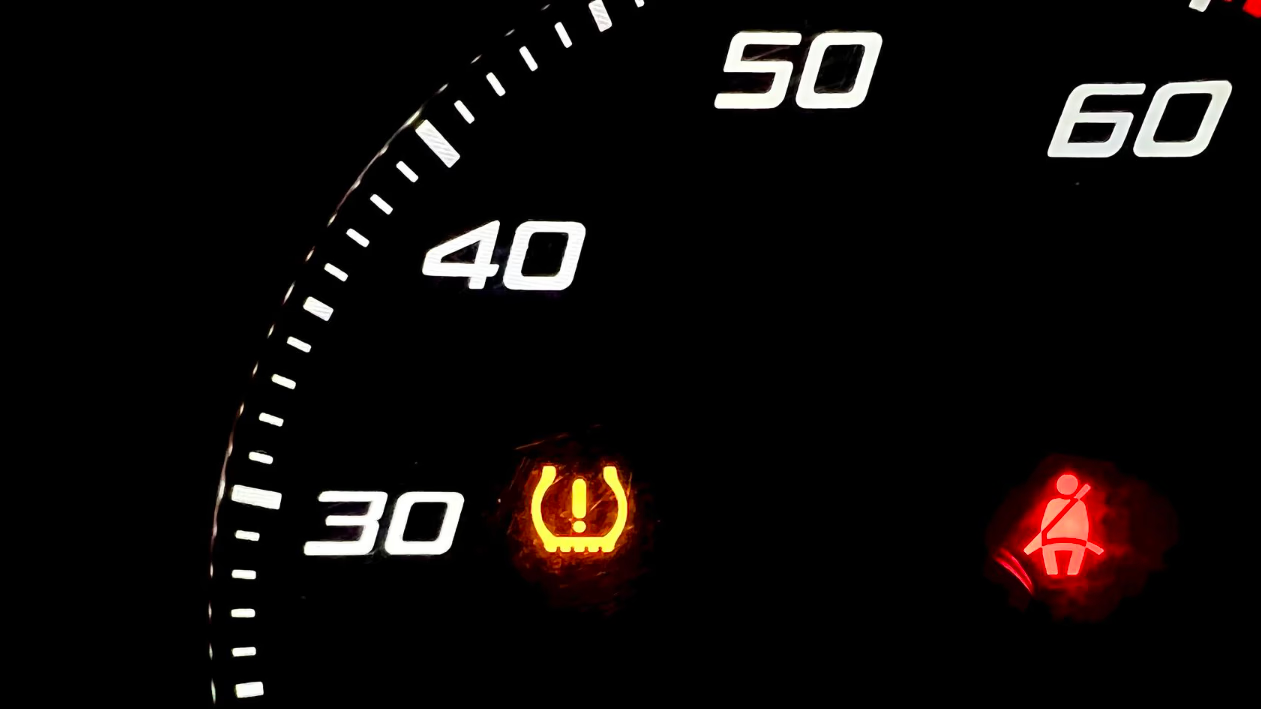
The tire pressure light, the amber symbol shaped like a horseshoe with an exclamation point in the middle, comes from your car’s Tire Pressure Monitoring System (TPMS). Under the federal safety standard for tire pressure monitoring systems, it has to come on when at least one tire is 25% or more below the pressure your carmaker recommends. It is not a flat tire alarm and it doesn’t prove that anything is punctured. Think of it as a low-fuel light for air: a signal to check, not a diagnosis.
How the car knows depends on the system it uses. Most vehicles have direct TPMS, with a small battery-powered sensor inside each wheel that measures pressure. Some models, including many recent Hondas and some Mazdas, use indirect TPMS instead. It has no pressure sensors at all and relies on the ABS wheel speed sensors: an underinflated tire has a slightly smaller rolling diameter, so it spins faster than the others. That difference matters later, because indirect systems usually need a manual reset after you add air.
Steady or flashing: what the light is telling you
The way the light behaves is just as important as the fact that it’s on. The same federal standard requires a separate signal for a system fault: the light flashes for 60 to 90 seconds after you turn on the ignition, then stays lit.
Light behavior
What it usually means
What to do
Steady from the start
One or more tires are low on air
Check all four tires with a gauge and inflate to spec
Flashes for about a minute, then stays on
A TPMS fault (dead sensor battery, damaged sensor, system error)
Have the system scanned; adding air won’t fix it
Comes on in the morning, goes off while driving
A tire sits right at the warning threshold
Check pressure cold and top up before it gets worse
Why the Light Comes On When Your Tires Look Fine
Tires don’t sag much until they’re seriously low, because the sidewalls and internal belts hold their shape. A tire that is 6 or 7 PSI under spec can look identical to its neighbors, which is why a visual check in the driveway tells you almost nothing. What actually pushes the reading below the line is usually a combination of two things: slow, normal air loss and a drop in temperature.
Cool mornings push an already low tire over the line
Air contracts as it cools. As a rule of thumb, tire pressure drops about 1 PSI for every 10°F the temperature falls. On Oahu, the gap between the coolest hour before sunrise and mid-afternoon is usually around 10 to 15°F, a bit more in upland neighborhoods like Mililani and Wahiawā on clear winter nights. A passing shower can cool the tires a few more degrees. That adds up to a loss of roughly 1 to 2 PSI overnight.
On its own, that’s nowhere near enough to set off a warning on a properly inflated tire. The rest comes from time. Even a healthy tire with no puncture can lose up to 1 PSI every month as air slowly seeps through the rubber. Go four or five months without a gauge check and the tire is already sitting just above the threshold. Then one cool morning takes away the last PSI or two, and the light comes on.
The morning chill is usually the last straw, not the cause. A light that comes on at dawn is telling you the tire has been running low for a while.
By mid-afternoon the sun and the road have warmed the air inside again, pressure climbs back over the threshold, and the light goes off. That’s why the warning can seem to come and go “for no reason” while the actual problem, an underinflated tire, stays exactly where it was.
Filling up in the afternoon heat sets you up for a low morning
There’s a second, very common trap. Many drivers top up their tires at a gas station in the middle of the day, after driving there in the sun. Hot tires read several PSI higher than cold ones. If you fill them to the door-sticker number while they’re warm, you’ve effectively set them below spec, and the next cool morning reveals it. For the same reason, never let air out of hot tires because the gauge shows a number above the sticker. The recommended pressure always refers to a cold tire: one that has been parked for at least three hours or driven no more than a mile or so.
When It’s Not the Weather: Other Causes of a Tire Pressure Warning
If you set all four tires to the correct pressure when cold and the light returns within days, something other than temperature is at work. These are the usual suspects:
A slow leak. A nail or screw in the tread, a loose or worn valve core, or corrosion where the tire seals against an alloy wheel can let air out a little at a time without any visible damage. On Oahu, that last one is more common than on the mainland, since salt air attacks metal parts all over your car, wheels and valve stems included.
A weak TPMS sensor battery. Direct sensors run on sealed batteries that typically last 5 to 10 years. When one fades, you’ll usually get the flashing fault warning rather than a steady low-pressure light.
A damaged or corroded sensor. A sensor knocked by a curb, a tire machine or road debris, or a valve stem eaten by corrosion, can send a bad reading or none at all.
New tires, a rotation or new sensors without a relearn. Depending on the car, the system may need to relearn sensor positions or register new sensor IDs. Until it does, it can show a fault or flag the wrong wheel.
An indirect system that wasn’t recalibrated. If your car uses indirect TPMS, adding air isn’t enough. The system has to be reset (usually with a button or a menu in the dashboard display) so it learns the new “normal.”
Is It Safe to Keep Driving With the Light On?
For a few careful miles to a gas station or a shop, usually yes. But don’t treat it as background noise. An underinflated tire flexes more, builds up more heat, and wears faster along its outer edges, which cuts directly into how long your tires last on Oahu. It also costs you fuel, makes the steering feel vaguer, and weakens grip and braking on wet roads. At freeway speeds on H-1, a badly underinflated tire can overheat and fail.
Pull over and check right away if the light comes on suddenly while you’re driving, if one tire looks visibly low, or if you notice a thumping noise, vibration or the car drifting. A car that keeps pulling to one side can point to uneven tire pressure, but if the pull stays after all four tires are set correctly, alignment or suspension is the more likely cause.
What to Do When the Tire Pressure Light Comes On
A five-minute self-check solves the problem more often than not. Do it first thing in the morning, before driving, so the readings reflect cold tires:
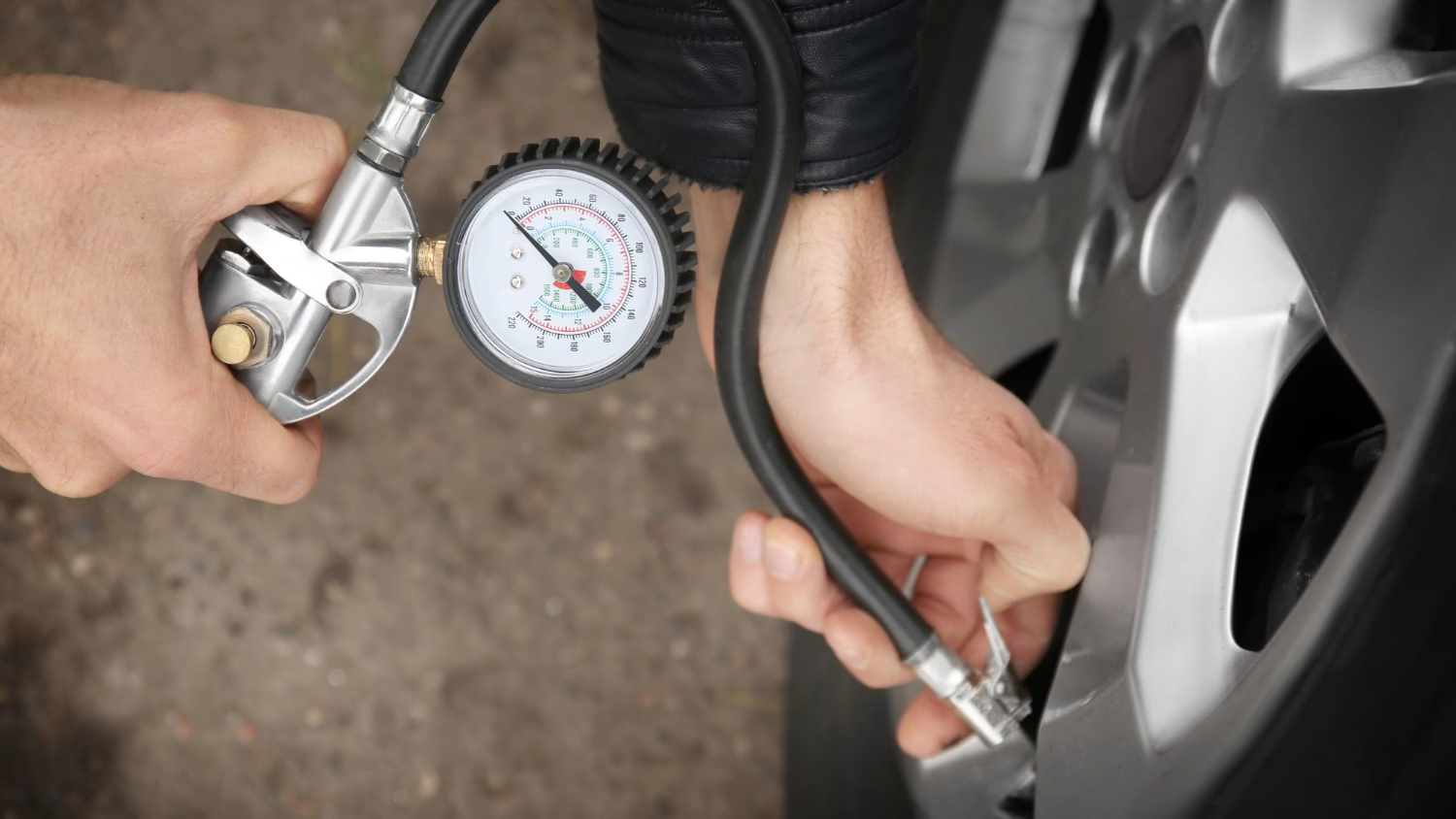
Check all four tires with a gauge, plus the spare if your car monitors it. The gas station gauge built into the air hose is fine in a pinch, but a cheap handheld gauge of your own is more reliable.
Look the tires over for a screw or nail in the tread, a bulge on the sidewall, or fine cracks in the rubber, which can be an early sign of tire dry rot.
Inflate to the number on the sticker inside the driver’s door jamb. The “max PSI” stamped on the tire sidewall is a limit for the tire, not a target for your car.
Reset the system if your car needs it. Direct systems usually turn the light off on their own after a few miles of driving. Indirect systems typically need the reset procedure described in your owner’s manual.
Recheck the same tire in a few days. If one tire keeps losing more than the others, it almost certainly has a slow leak.
If the light stays on after all four tires are at the right cold pressure, the problem is likely the sensor or the system, not the air.
That’s the point where guessing gets expensive and a scan tool earns its keep. At Top Level Cars in Waipahu, our mechanics handle everything from finding slow leaks and repairing punctures to TPMS sensor replacement and relearns as part of our tire services. When the cause isn’t obvious, a full vehicle diagnostic check reads the TPMS codes and pinpoints the faulty sensor, and you get a written estimate to approve before any work starts. And to keep the light from catching you off guard again, add a monthly gauge check to your regular car maintenance routine.
Tire Pressure Light: Quick Answers for Oahu Drivers
Can the tire pressure light come on without a tire actually leaking?
Yes. Tires lose a little air through the rubber every month, and a cool morning lowers pressure further. Together, those two can trip the light with no puncture at all. A temperature drop alone rarely does it on Oahu, so a warning usually means the tire was already running low.
Why does the light come on more in the morning or after it rains?
Cool overnight air and rain lower the temperature of your tires, and the pressure drops with it, roughly 1 PSI for every 10°F. If a tire was already close to the warning threshold, that small drop is enough to switch the light on.
Why does the light turn off after I start driving?
Driving and afternoon sun warm the tires, and the air inside expands enough to push the pressure back above the threshold. The tire is still underinflated when cold, which is why you should check it before driving, not after.
How do I reset the tire pressure light?
First set all four tires to the pressure on the door-jamb sticker. Direct TPMS usually clears itself after a few miles of driving. Cars with indirect TPMS need a manual reset through a button or the dashboard menu, as described in the owner’s manual.
Can I still drive with the tire pressure light on?
You can usually drive a short distance to a gas station or a shop, but don’t put it off. Underinflated tires wear faster, grip worse on wet roads, and run hotter at highway speed. A flashing light means a system fault, so the car can’t warn you properly about low pressure until it’s fixed.
How do I know if the TPMS sensor is bad and not the tire?
If the light flashes for about a minute at startup before staying on, or stays lit even though a gauge shows all four tires at the correct cold pressure, the sensor or system is the likely culprit. A diagnostic scan reads the TPMS codes and shows exactly which sensor has failed.
Read what our satisfied customers have to say about our services.
Great experience. I brought my Prius in for a diagnostic on a dash board error light. Plus I knew that the rear bearings needed to be replaced.
Their attentive behavior was immediate as I scheduled my Monday morning shop visit and the owner responded on a Sunday to schedule.
Even though there was a diagnostic fee the amount was applied to the repair.
In and out in the time committed on the estimate. Clean, very clean facilities from to the waiting room and throughout the shop.
I will continue to use them for future Maintinance and repair’s.
Robert G.
I recently had my Honda serviced at Top Level Cars, and I couldn't be more pleased with the experience. From the moment I walked in, the staff was incredibly welcoming and professional. They took the time to listen to my concerns and provided a detailed explanation of the necessary repairs.
The quality of the work was outstanding. My Honda now runs smoother than ever, and I have complete confidence in the repairs they performed. The technicians clearly know their craft, and their attention to detail was evident in the final result.
What stood out the most was the transparency throughout the entire process. I was kept informed of the progress and costs at every step, ensuring there were no surprises when it came time to settle the bill. The prices were fair and competitive, especially considering the high level of service provided.
Overall, Top Level Cars exceeded my expectations. I highly recommend them to anyone in need of reliable and trustworthy auto service. I will definitely be returning for all my future car maintenance and repair needs.
Denis G.
First impressions: EXCELLENT! We have a Mercedes ML430 that needs some work on. Nick responded immediately and gave us a fair price, the best one we could find on the island. After checking, he recommended only one of the four repairs that others pushed for, and even that with no hurry whatsoever. In fact we felt so well treated by him that we didn’t mind doing his recommended work on our first visit, because we want the good service at TopLevel Cars recognized and paid for. We will definitely return!
Mark M.
If you have car trouble go to Top Level Cars and ask for Demetri! The service was incredible and the cost is the BEST on the island. He was able to take my car in and have it done the same day! He is super knowledgeable and was patient when explaining the work my car needed. I will 100% be bringing my car back for any future services.
Jennifer M.
Top Level Cars are true professionals when it comes to auto repair. I have a Mercedes CL550 that needed servicing. They took me in right away and did an excellent job. I recommend Top Level Cars to anyone who values outstanding service and fair prices. I will only trust Top Level Cars with my car repairs.
Gus N.
The Customer Service here is top notch! Shout out to a great team!! They were the first ones to get back to me and help me with my Tire issue. I have secured my appointment and will be back to have more services done.
Kristina J.
Top Level Cars provided an outstanding experience from start to finish. Their pricing was fair and transparent, exactly as advertised with no surprises. Communication was exceptional; they promptly answered all my questions and kept me informed throughout the process. The service was incredibly fast—I was in and out in no time. They made the entire process smooth and hassle-free. I highly recommend Top Level Cars to anyone looking for a reliable and trustworthy auto repair shop.



 Brakes