Of all the warning lights on your dashboard, the red oil can gives you the least time to think. A check engine light can sometimes wait a day or two. This one can’t, because an engine running without proper oil pressure can suffer serious, permanent damage within minutes, often before you’ve covered more than a few miles. The decision you make in that first moment usually separates a quick, affordable fix from a four- or five-figure engine bill. The reassuring part is that drivers who react calmly and stop in time almost always keep their engine in one piece.
What Does the Oil Pressure Light Mean?
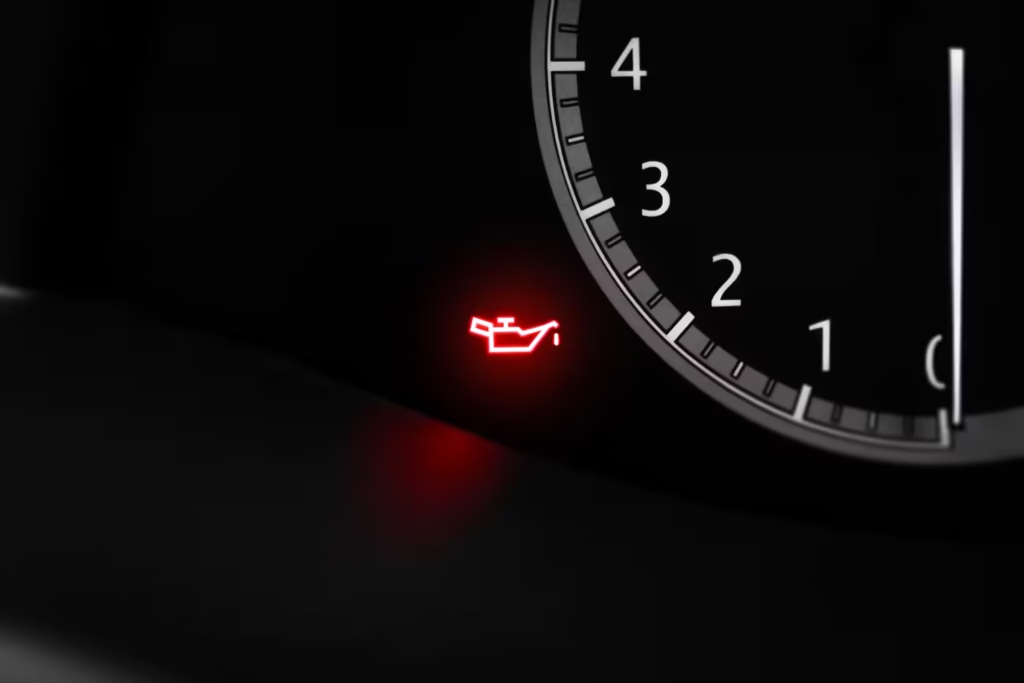
The oil pressure light is a red dashboard warning, usually shaped like an old-fashioned oil can dripping a single drop, that comes on when the pressure in your engine’s lubrication system falls below a safe minimum. It reacts in real time to how hard the oil is being pushed through the engine and has nothing to do with mileage or service schedules. It also doesn’t measure how much oil is in the pan, which is why it can come on even when the dipstick reads full.
Think of oil pressure as the “blood pressure” of your engine. When it drops too low, the crankshaft bearings, camshaft, and other moving parts stop getting the protective oil film they depend on. Low oil pressure can lead to severe engine damage, so the first move is to check the oil level and keep the car off the road if the warning doesn’t go away. Driving on “to see if it goes out” only gives the damage more time to build.
Common Causes of the Oil Pressure Warning Light
The light tells you that pressure is too low, but it can’t tell you why. These are the culprits we find most often in the shop:
Low oil level: with too little oil in the pan, the pump has nothing to pressurize.
An oil leak: oil escaping through a worn seal or gasket gradually starves the system.
A clogged oil filter or pickup screen: sludge and debris restrict the flow of oil. Most filters have a bypass valve that keeps oil moving when the element clogs, but that oil then circulates unfiltered, which is one more reason to stay on top of oil filter changes.
A faulty oil pressure sensor or wiring: sometimes the oil is fine and the sensor is simply giving a false reading.
A worn oil pump: the pump that builds pressure can wear out and lose its ability to do its job.
Worn engine bearings: as bearing clearances grow with mileage, oil escapes more easily and pressure drops, especially at a hot idle.
Oil that’s too thin or broken down: the wrong viscosity, or oil that’s overheated or diluted with fuel, can’t hold pressure under heat and load. If you’re not sure which motor oil your car actually needs, the owner’s manual and your mechanic are the best guides.
Each of these has a very different fix and cost, which is exactly why guessing is risky. Here’s a closer look at the most common ones.
Low oil level or leaks
This is the most common reason of all, and the mechanism is simple. Your oil pump can only pressurize oil that’s actually in the pan. When the level drops low enough, the pickup starts drawing air along with oil, especially in corners, under hard braking, or on steep driveways, and pressure collapses. A light that flickers on in turns and goes out on a straight road is a classic sign of low oil level.
Low level usually comes either from normal oil consumption that nobody topped off or from a leak. The usual suspects for leaks are the oil pan gasket, the valve cover gasket, and the front and rear crankshaft seals. Dark spots on your driveway or garage floor are a telltale sign, and a proper oil leak repair will stop the loss before it ever triggers the light again.
Worn oil pump or failing bearings
Here’s where the “blood pressure” analogy really earns its keep. The oil pump is the heart of the system, and the engine bearings are the surfaces that rely on a constant, pressurized film of oil to ride on. When the pump wears out or the bearings themselves start to fail, that protective film breaks down. Once it is gone, the bearings and crankshaft come into direct metal-to-metal contact, and wear that would normally take years can happen in minutes.
An early hint of this kind of wear is a light that flickers at a hot idle, for example at a red light after a long drive, and goes out as soon as you touch the gas. Once grinding starts inside the engine, damage accelerates quickly, so a low-pressure warning tied to pump or bearing wear is never one to ride out.
Climate-related causes on Oahu
Oahu’s weather is gentler than a desert summer, but it still puts steady stress on engine oil. Heat speeds up oxidation, the chemical breakdown that wears out the oil’s additives and gradually turns it into sludge. Short, stop-and-go hops around Waipahu, Pearl City, and Kapolei add to the problem, because the engine rarely runs long enough to boil off the moisture that condenses inside it in humid air.
Stretch your oil change intervals too far under these conditions and the oil can either thin out under heat or leave sludge that restricts flow, and both can drag pressure down. Dark, gritty oil on the dipstick is one of the signs your car needs an oil change, and staying on schedule with a routine oil change service is the easiest way to keep island conditions from working against your engine.
Oil Pressure Light vs. Oil Change Light: Don’t Confuse Them
This mix-up happens constantly, and it matters a lot, because the two warnings carry completely different levels of urgency. The red light is a safety alarm for your engine right now, while the service reminder is a friendly maintenance nudge. Some cars also have a third, yellow oil warning that’s easy to mistake for either of them.
Warning
Typical color
What it means
What to do right away
Oil pressure light
Red oil-can icon
Oil pressure is dangerously low and the engine is at risk
Stop safely and shut off the engine
Low oil level warning (some models)
Yellow or amber oil-can icon
The oil level is getting low, but pressure is still OK
Check the dipstick and top off soon
Oil change / service reminder
Yellow or amber, often a wrench icon or text message
Service is due soon based on mileage or time
Schedule an oil change; no emergency
Symbols and colors vary by make and model, so your owner’s manual has the final word if you’re not sure which one you’re looking at. If yours turns out to be the service reminder, there’s no need to panic, and once the oil change is done you’ll just want to clear it, which is where a quick guide on resetting the oil change light comes in handy. If the light is red and oil-can shaped, though, treat it as the real thing.
Why Ignoring the Oil Pressure Light Is Risky
Mechanics sound firm about this light for a good reason: low oil pressure can cause serious damage faster than almost any other fault on your car. Once the oil film is gone, bearings start rubbing against the crankshaft, and a complete loss of lubrication typically ends with seized bearings and total engine failure. Turbocharged engines are even more exposed: the turbo’s bearings spin at extremely high speeds on the same oil supply, and according to Garrett Motion, oil starvation and contamination are behind more than 90% of turbo failures. On engines with hydraulic timing chain tensioners, low pressure can also let the chain go slack and rattle, which adds wear to the whole timing system.
The cost gap is what makes this so painful. Finding the cause usually comes down to a few targeted checks: the oil level, a test with a mechanical pressure gauge to confirm whether pressure is really low, and an inspection of the sensor and wiring. That’s a fraction of the price of replacing an engine that seized because someone drove it “just a little farther,” which can easily run into thousands of dollars. The encouraging part is that if you stop in time, the engine itself is usually fine, and you’re simply fixing whatever caused the pressure to drop.
What to Do When the Oil Pressure Light Comes On
If that red light appears, here’s exactly what to do, in order:
Pull over safely. Signal, ease off the road, and find a flat spot away from traffic. If you’re stuck in heavy traffic on the H-1, our step-by-step guide on what to do if your car breaks down covers how to get off the road safely.
Shut the engine off right away. Every second it runs with low pressure adds wear, and turning it off is the single most protective thing you can do.
Wait a few minutes, then check the oil. Let the oil drain back into the pan, pull the dipstick, wipe it, reinsert it, and read the level.
Top off only if the level is low and you have the right oil. If the light goes out within a few seconds of restarting, low oil was most likely the cause, but have the car checked soon to find out where the oil went. If the level was fine, you can’t tell what’s going on, or the light stays on after topping off, leave the engine off.
Call for a tow instead of limping it in. Getting the car trailered to the shop costs far less than a new engine.
This is also where a stubborn myth needs busting: “it’s just a short drive, it’ll be fine.” Continuing to drive with the warning on is a gamble that rarely pays off. A few miles with low oil pressure are enough to ruin a bearing, and that damage is permanent.
When to Call Top Level Cars for Oil Pressure Diagnostics
Once you’ve stopped safely, the smartest next move is to let a technician find the cause instead of guessing in the driveway. Is it a couple of quarts low, a leaking gasket, a bad sensor, or a failing pump? Those answers are worlds apart, and proper professional diagnostics tell you which one you’re actually dealing with before any parts get replaced. If the problem turns out to be internal, our engine repair and maintenance team can handle it right here in Waipahu.
Drivers across Waipahu, Pearl City, and Kapolei choose Top Level Cars because we lay out the costs plainly, with no hidden fees and no pressure to buy things your car doesn’t need. We also offer a permanent 10% labor discount for our military ohana. If your oil pressure light is on, don’t gamble with your engine. Call Top Level Cars today or book an appointment, and let’s protect what’s under your hood.
Oil Pressure Light: Quick Answers for Oahu Drivers
Can I keep driving if the oil pressure light comes on but the dipstick shows a full oil level?
No. A full dipstick with a red oil pressure light often points to a failing pump, a clogged pickup screen, a bad sensor, or a deeper internal problem, so you should still shut the engine off and have it diagnosed rather than drive on it.
What’s the difference between the oil pressure light and the regular oil change reminder light?
The red oil-can light is an urgent warning that pressure is dangerously low and your engine needs protection now. The yellow or amber service reminder is a mileage- or time-based nudge that routine maintenance is due soon, so it isn’t an emergency.
Can Hawaii’s heat and humidity cause the oil pressure light to turn on?
Indirectly, yes. Heat speeds up oil breakdown, and humid air combined with short trips leaves moisture in the engine. If oil changes are stretched too far in our island climate, that degraded oil can struggle to hold proper pressure.
Is it safe to drive a few more miles to a repair shop if the oil pressure light stays on?
No. Even a short drive with low oil pressure can cause permanent bearing or engine damage, so it’s far safer and cheaper to have the car towed than to risk those final few miles.
Read what our satisfied customers have to say about our services.
Great experience. I brought my Prius in for a diagnostic on a dash board error light. Plus I knew that the rear bearings needed to be replaced.
Their attentive behavior was immediate as I scheduled my Monday morning shop visit and the owner responded on a Sunday to schedule.
Even though there was a diagnostic fee the amount was applied to the repair.
In and out in the time committed on the estimate. Clean, very clean facilities from to the waiting room and throughout the shop.
I will continue to use them for future Maintinance and repair’s.
Robert G.
I recently had my Honda serviced at Top Level Cars, and I couldn't be more pleased with the experience. From the moment I walked in, the staff was incredibly welcoming and professional. They took the time to listen to my concerns and provided a detailed explanation of the necessary repairs.
The quality of the work was outstanding. My Honda now runs smoother than ever, and I have complete confidence in the repairs they performed. The technicians clearly know their craft, and their attention to detail was evident in the final result.
What stood out the most was the transparency throughout the entire process. I was kept informed of the progress and costs at every step, ensuring there were no surprises when it came time to settle the bill. The prices were fair and competitive, especially considering the high level of service provided.
Overall, Top Level Cars exceeded my expectations. I highly recommend them to anyone in need of reliable and trustworthy auto service. I will definitely be returning for all my future car maintenance and repair needs.
Denis G.
First impressions: EXCELLENT! We have a Mercedes ML430 that needs some work on. Nick responded immediately and gave us a fair price, the best one we could find on the island. After checking, he recommended only one of the four repairs that others pushed for, and even that with no hurry whatsoever. In fact we felt so well treated by him that we didn’t mind doing his recommended work on our first visit, because we want the good service at TopLevel Cars recognized and paid for. We will definitely return!
Mark M.
If you have car trouble go to Top Level Cars and ask for Demetri! The service was incredible and the cost is the BEST on the island. He was able to take my car in and have it done the same day! He is super knowledgeable and was patient when explaining the work my car needed. I will 100% be bringing my car back for any future services.
Jennifer M.
Top Level Cars are true professionals when it comes to auto repair. I have a Mercedes CL550 that needed servicing. They took me in right away and did an excellent job. I recommend Top Level Cars to anyone who values outstanding service and fair prices. I will only trust Top Level Cars with my car repairs.
Gus N.
The Customer Service here is top notch! Shout out to a great team!! They were the first ones to get back to me and help me with my Tire issue. I have secured my appointment and will be back to have more services done.
Kristina J.
Top Level Cars provided an outstanding experience from start to finish. Their pricing was fair and transparent, exactly as advertised with no surprises. Communication was exceptional; they promptly answered all my questions and kept me informed throughout the process. The service was incredibly fast—I was in and out in no time. They made the entire process smooth and hassle-free. I highly recommend Top Level Cars to anyone looking for a reliable and trustworthy auto repair shop.



 Oil Change