How Often Should You Replace Brake Pads? An Honest Oahu Guide
Top Level Cars
8 min read
Here’s the short answer most drivers are looking for: brake pads typically last somewhere between 25,000 and 70,000 miles, a range Consumer Reports confirms depends heavily on how and where you drive. That’s a wide window, and the reason it’s so wide matters more than the number itself. A pad that survives 70,000 flat-highway miles on the mainland might tap out closer to 30,000 here on the island, and it has nothing to do with the quality of your car.
So instead of memorizing one magic mileage figure, let’s walk through what actually wears a pad down, how to catch a tired set early, and how to read your own brakes before a small fix becomes an expensive one. No scare tactics, just straight talk from folks who look at Oahu brakes every day.
What Actually Wears Down a Brake Pad?
Think of a brake pad a bit like a pencil eraser. Every time you press the pedal, the pad clamps against the spinning rotor and a thin layer rubs away, exactly the way an eraser leaves a little of itself behind on the paper. One stop barely registers, but thousands of stops add up, and eventually the eraser is worn down to the nub.
A few things speed that erasing up. Stop-and-go traffic is the big one, because every red light and every slowdown is another swipe of the eraser. Hard or frequent braking heats the pad and grinds it faster than smooth, gradual stops. Heavier vehicles, think loaded trucks and full SUVs, carry more momentum, so the pads work harder to shed it. And pad material quality matters too, since cheaper compounds simply wear thinner sooner. All of this is why a periodic brake pad thickness check tells you far more about your remaining pad life than the odometer ever will.
Why Oahu’s hills and highways wear brake pads faster
This is the part no mainland article will tell you, because most of them are written for flat, open freeways. Sustained downhill braking is uniquely hard on pads. When you ride the brakes down a long, steep grade, the pad and rotor can’t shed heat between stops the way they do on level ground. That heat softens the pad material and wears it away faster, and Oahu has plenty of grades to test it on.
Anyone who regularly drives the Pali, the Likelike, or the long descents off the H3 knows the feeling of a car that wants to keep gaining speed downhill. Add in daily H1 highway brake wear from the constant merge-brake-accelerate rhythm through town and around Pearl City, and you’ve got a driving profile that simply asks more of your pads than a Kansas commute ever would.
None of this is cause for alarm. It just means island drivers should think in terms of terrain, not just miles, and get a little more vigilant about checking. If you want to be gentler on your brakes to begin with, our guide to safe braking in Hawaii’s driving conditions covers a few habits that genuinely extend pad life.
Signs Your Brake Pads Need Attention Now
Your car is surprisingly good at telling you when the pads are getting thin. The trick is knowing what to listen and feel for, and none of these signs should send you into a panic, because they’re common and easy to catch early when you’re paying attention:
Squealing. That high-pitched chirp when you brake is often the built-in wear indicator, a little metal tab designed to squeal on purpose and remind you it’s time to look.
Grinding. A harsher metal-on-metal grinding sound usually means the pad material is gone and metal is contacting the rotor. This one shouldn’t wait.
Pedal or steering vibration. A pulsing or shuddering feel under braking can point to worn pads or uneven rotors. We dig into that specific symptom in our piece on why your car shaking when you brake happens.
Longer stopping distance. If it takes noticeably more room to come to a stop, your pads may be past their prime.
A dashboard brake warning light. Some vehicles have sensors that light up when pads reach a set thickness. Don’t ignore it.
Catch any one of these early and a fix is usually simple and affordable. Ignore them and you risk chewing up rotors too, which turns a small job into a bigger one.
How to Check Brake Pad Thickness Yourself (and When to Call a Pro)
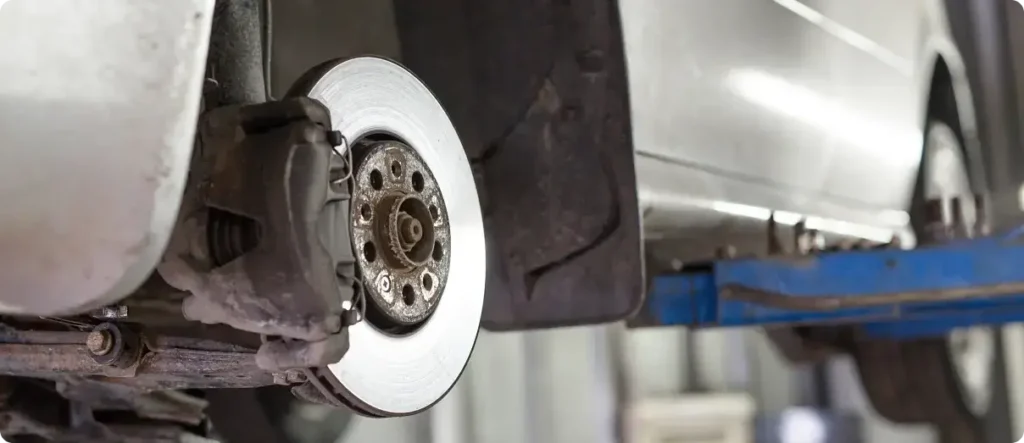
You can get a rough read on your own pads without removing a single wheel. Look through the spokes of your rim at the brake caliper, and you’ll see the pad pressed against the shiny rotor. What you’re eyeballing is how much friction material is left. According to AAA Automotive, once a pad thins to roughly a quarter of an inch you’re entering the caution zone, and it’s smart to have it inspected before it grinds down to metal. AAA also suggests folding a quick brake pad thickness check into every tire rotation, which is an easy habit to keep.
That said, eyeballing it through the spokes is a ballpark, not a measurement. Pads don’t always wear evenly, the inner pad often wears faster than the outer, and you can’t see the inner one from outside. For a precise reading a technician uses a micrometer and pulls the wheel, so if your quick look leaves you unsure, that’s exactly the moment to let a pro confirm it.
Brake Pad Replacement Intervals by Driving Style
Because terrain and driving style matter so much, here’s a realistic look at how a brake pad wear interval shifts depending on how you actually use your car. Treat these as guideposts for when to change brake pads, not guarantees, and remember that an inspection always beats a guess.
Driving profile
Typical pad life
Flat highway commuting
50,000–70,000 miles
Oahu stop-and-go traffic
30,000–45,000 miles
Frequent H1 / H3 / Likelike grade driving
25,000–40,000 miles
Towing or heavily loaded vehicles
20,000–35,000 miles
If your daily routine lives in the bottom three rows, and most island driving does, plan to have your pads looked at on the shorter end of the manufacturer’s schedule. It’s a small step that keeps you off the metal-on-metal side of the equation.
Brake Inspection at Top Level Cars: What We Check
When you bring your car in for a brake inspection at Oahu’s Top Level Cars, we look at the whole system, not just the pads. A thorough check covers pad thickness on all four corners, rotor condition and thickness, caliper function and any sticking, and the brake fluid, since old, moisture-laden fluid quietly undermines braking performance. If your pads are fine, we’ll tell you they’re fine. That transparent, no-upsell promise is the whole point, and it’s why so many neighbors around Waipahu, Pearl City, and Kapolei keep coming back. If we do find worn pads or scored rotors, our team handles professional brake pad and rotor service with clear pricing before any work starts.
Not sure where your pads stand after reading all this? The easiest next step is to book your brake inspection and let us take the guesswork out of it. A few minutes on the lift beats wondering every time you head down the Pali.
Frequently Asked Questions About Brake Pads Replacement
How do I know if my brake pads are worn out without taking off the tire?
Peek through the spokes of your wheel at the pad pressed against the rotor and estimate the remaining thickness. If it looks close to a quarter inch or less, or you hear squealing, it’s time for a proper inspection.
Can I keep driving a little longer on worn brake pads?
A short trip to the shop is usually fine, but driving on badly worn pads risks grinding into your rotors and lengthening your stopping distance. It’s cheaper and safer to address it promptly rather than gamble on an island full of hills.
Do brake pads really wear out faster in Hawaii than on the mainland?
Yes. Sustained downhill braking on grades like the Pali, Likelike, and H3, plus constant stop-and-go traffic, generates more heat and wear than flat mainland highway driving.
How much does brake pad replacement cost in Oahu?
Cost varies by vehicle, pad quality, and whether rotors also need service, so we give you a clear quote before any work begins. Ask about our specials and military discount, which can bring the price down.
If my brake pads are worn, do I need new rotors too?
Not always. If the pads were caught early and the rotors are still smooth and within spec, you may only need pads, which is exactly why an early inspection saves money.
Read what our satisfied customers have to say about our services.
Great experience. I brought my Prius in for a diagnostic on a dash board error light. Plus I knew that the rear bearings needed to be replaced.
Their attentive behavior was immediate as I scheduled my Monday morning shop visit and the owner responded on a Sunday to schedule.
Even though there was a diagnostic fee the amount was applied to the repair.
In and out in the time committed on the estimate. Clean, very clean facilities from to the waiting room and throughout the shop.
I will continue to use them for future Maintinance and repair’s.
Robert G.
I recently had my Honda serviced at Top Level Cars, and I couldn't be more pleased with the experience. From the moment I walked in, the staff was incredibly welcoming and professional. They took the time to listen to my concerns and provided a detailed explanation of the necessary repairs.
The quality of the work was outstanding. My Honda now runs smoother than ever, and I have complete confidence in the repairs they performed. The technicians clearly know their craft, and their attention to detail was evident in the final result.
What stood out the most was the transparency throughout the entire process. I was kept informed of the progress and costs at every step, ensuring there were no surprises when it came time to settle the bill. The prices were fair and competitive, especially considering the high level of service provided.
Overall, Top Level Cars exceeded my expectations. I highly recommend them to anyone in need of reliable and trustworthy auto service. I will definitely be returning for all my future car maintenance and repair needs.
Denis G.
First impressions: EXCELLENT! We have a Mercedes ML430 that needs some work on. Nick responded immediately and gave us a fair price, the best one we could find on the island. After checking, he recommended only one of the four repairs that others pushed for, and even that with no hurry whatsoever. In fact we felt so well treated by him that we didn’t mind doing his recommended work on our first visit, because we want the good service at TopLevel Cars recognized and paid for. We will definitely return!
Mark M.
If you have car trouble go to Top Level Cars and ask for Demetri! The service was incredible and the cost is the BEST on the island. He was able to take my car in and have it done the same day! He is super knowledgeable and was patient when explaining the work my car needed. I will 100% be bringing my car back for any future services.
Jennifer M.
Top Level Cars are true professionals when it comes to auto repair. I have a Mercedes CL550 that needed servicing. They took me in right away and did an excellent job. I recommend Top Level Cars to anyone who values outstanding service and fair prices. I will only trust Top Level Cars with my car repairs.
Gus N.
The Customer Service here is top notch! Shout out to a great team!! They were the first ones to get back to me and help me with my Tire issue. I have secured my appointment and will be back to have more services done.
Kristina J.
Top Level Cars provided an outstanding experience from start to finish. Their pricing was fair and transparent, exactly as advertised with no surprises. Communication was exceptional; they promptly answered all my questions and kept me informed throughout the process. The service was incredibly fast—I was in and out in no time. They made the entire process smooth and hassle-free. I highly recommend Top Level Cars to anyone looking for a reliable and trustworthy auto repair shop.



 Brakes